
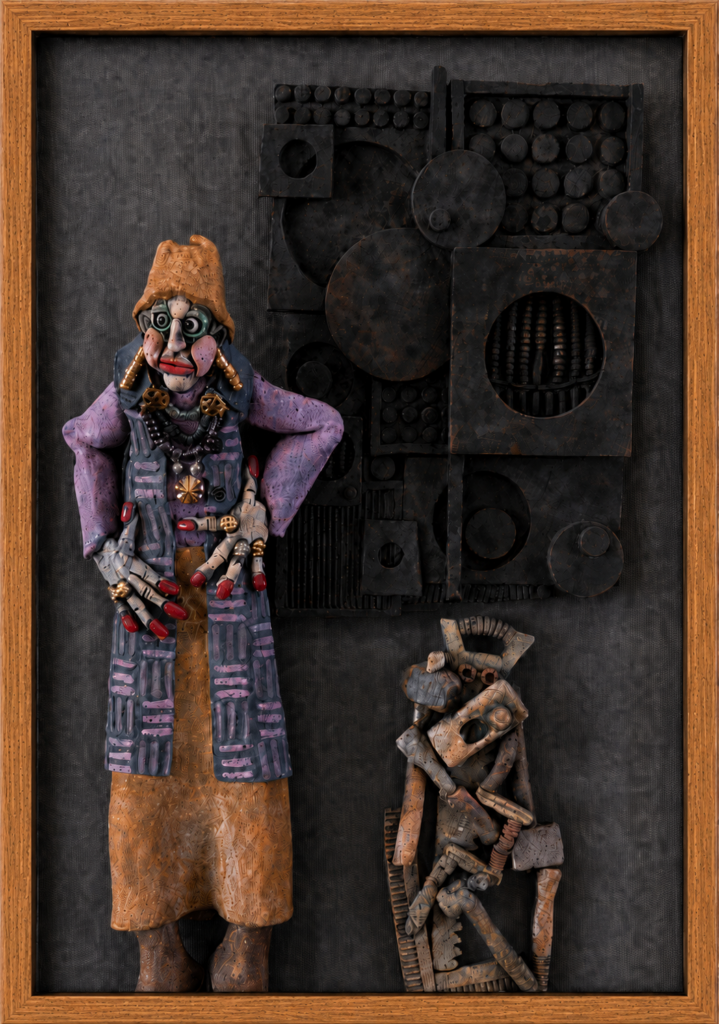
“I myself need, for my place of consciousness, a form. It’s almost like you are an architect that’s building through shadow and light and dark.” – Louise Nevelson, 1964
Louise Nevelson was an artist whose practice centered on sculpture, producing complex monochromatic constructions of salvaged wood and employing sculptural scale ranging from the tabletop to environments to public commissions. She was known for her monumental, mono-chromatic, wooden wall pieces and outdoor sculptures.
Nevelson immigrated with her family to Maine from present-day Kiev, Ukraine in 1905. In 1920, she moved to New York City, where she studied art in private lessons and at the Art Students League. After brief stints in Europe in the 1930s, she returned to New York and continued at the Art Students League, trained as a modern dancer, and joined the Works Progress Administration (WPA). Nevelson characterized the 1930s and 1940s as “a time of searching and finding myself as an artist.” She experimented with figurative work that sometimes veered toward abstractions across various mediums, including clay and painting.
Nevelson began working with her signature medium of foraged wood in the 1940s. In these works, she gathered materials from junkyards and city streets, constructing her sculptures through an additive process rather than carving. In 1941, she had her first solo exhibition. In the 1950s, she started painting her intricate assemblages black, which she claimed was the “most aristocratic color.” Nevelson experimented with early conceptual art using found objects and experimented with painting and printing before dedicating her lifework to sculpture. Usually created out of wood, her sculptures appear puzzle-like, with multiple intricately cut pieces placed into wall sculptures or independently standing pieces, often 3-D. In later years, her palette briefly shifted to all white and all gold in addition to black.
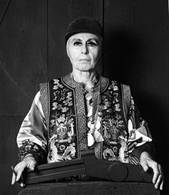
As Nevelson developed her frequently human-scale constructions and wall-based works, she built her sculptures out of scavenged or pre-made boxes. With those boxes, she then intuitively arranged found wooden scraps to create abstract compositions that activate a play of shadows. Her incorporation of fragments of everyday objects like chairs, moldings, and railings linked her sculptures to daily life, as in Sky Cathedral. At the same time, Nevelson unified her disparate materials with a single color and aimed to give them, in her words. “a spiritual life that surpasses the life they were created for.”
Sky Cathedral, 1958
Alongside her sculptures, by about 1957, Nevelson was creating room-sized works, ultimately deeming herself “the grandmother of environments.” During the 1960s, she also experimented with printmaking and other new materials including Plexiglas, as in Night Leaf. Beginning in 1969, she frequently received commissions for public works, adapting her process to prepare smaller-scale wood studies, such as Study for Bicentennial Dawn, and further expanding her medium to include metal in projects that were sited outdoors.
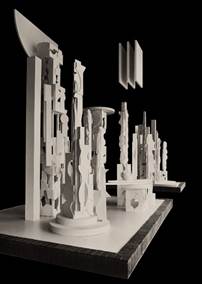
Bicentennial Dawn, 1976
In the 1960s, Nevelson began garnering hard-won public acclaim as her work was featured I a number of pivotal exhibitions. Entering her sixties, she was keenly attuned to the late-breaking nature of this attention, particularly I comparison to the career trajectories of many of her male contemporaries. Yet, as she put it, “No one could move me till I got what I wanted – on my terms, on earth… And the hardship gave me total freedom.”
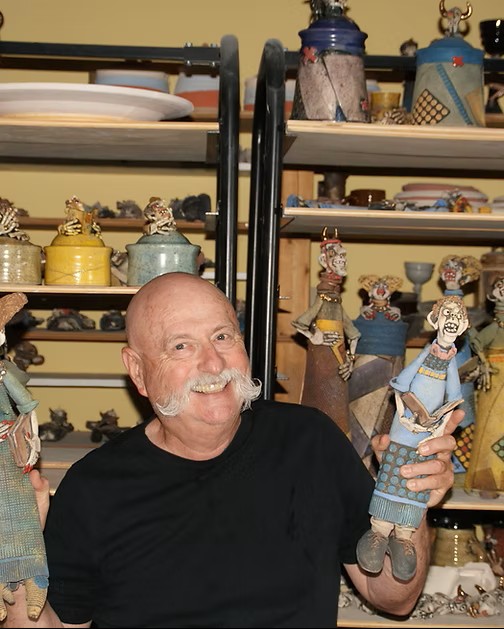
Dee Schaad was born and raised in Nebraska and has an MFA from Hixson-Leid College of Fine Arts at the University of Nebraska Lincoln. He taught ceramics at the University of Indianapolis for 39 years. He was chairman of the Department of Art and Design from 1994 through 2010. He currently is Professor Emeritus. His work is included in several books and in public and private collections and has been exhibited nationally. His writing has appeared in a number of National publications and he has made several instructional videos for American Art Clay Company. As a ceramist, his work covers a broad spectrum of ceramic processes. He works in both stoneware and earthenware. His work consists of large and small sculptural pieces and traditional, more functional vessel formatted objects. Dee Schaad was named University of Indianapolis’ Teacher of the Year for 2006. During the summer of 2007 he was awarded a Creative Renewal Arts Fellowship from the Arts Council of Indianapolis. Dee Schaad had an installation at the Indianapolis International Airport during 2014 and 2026. He continues to actively exhibit and conducts ceramic workshops throughout the United States. In July of 2025, he was selected to be one of 50 over 50 by “Indianapolis Monthly” magazine.